
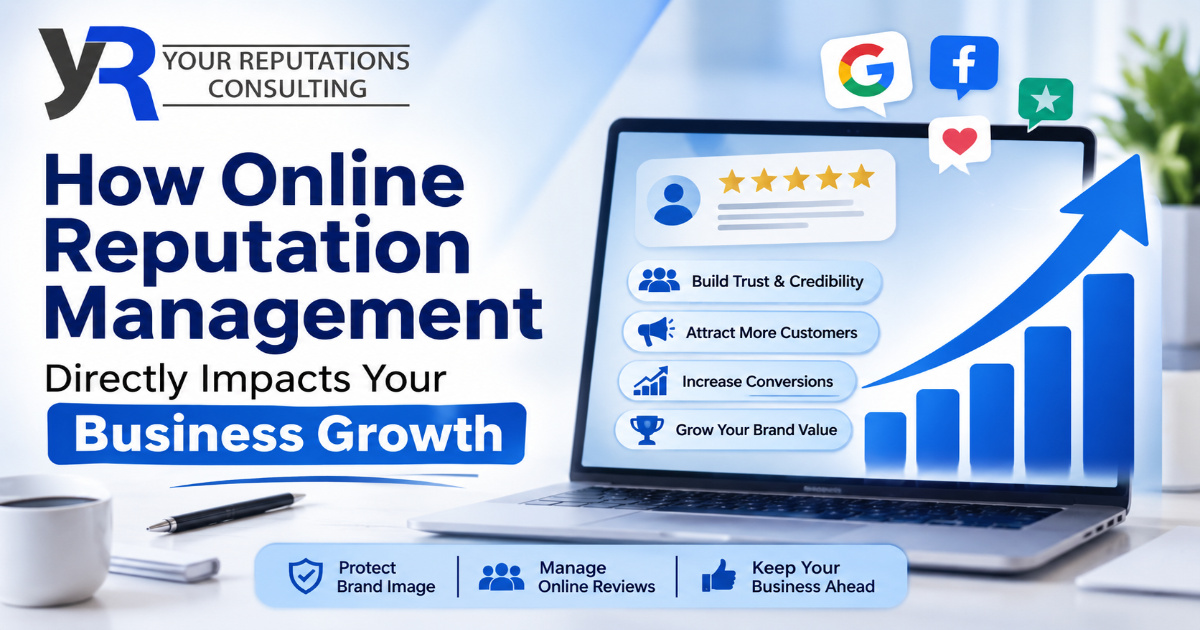
How Online Reputation Management Directly Impacts Your Business Growth


They see three bad reviews.
They leave.
No call. No enquiry. No second thought.
That is how quickly reputation can affect revenue.
People often assume that online reputation is just about collecting positive reviews or responding politely when someone complains. It isn't. Your digital reputation is the version of your business that customers meet before they ever speak to your sales team, visit your office, call your reception desk, or place an order.
And in a market where people can compare ten businesses in less than five minutes, that first impression carries real weight.
Look at a simple example. Someone in Noida needs a service and searches for a company on Google. One business has a strong rating, recent customer reviews, thoughtful responses, useful information and an active online presence. Another has an outdated profile, unanswered complaints and several reviews mentioning poor communication.
Which one gets the enquiry?
Probably not the second one.
This is where Online Reputation Management becomes a business-growth tool rather than a damage-control exercise.
Customers don't know your business the way you do.
You know how hard your team works. You know the quality of your product. You know that one angry customer misunderstood what happened. You know the backstory behind that one-star review.
The customer doesn't.
They see the screen.
That's it.
When someone searches your brand name, the results that appear on Google, review platforms, social media channels and other websites collectively shape their perception. A strong online presence can create confidence before the first conversation even begins. A messy one can create doubt before you've had a chance to explain anything.
That's a brutal reality of digital business.
And it's why reputation deserves the same attention as advertising, SEO and sales.
Think about your own behaviour for a second.
Would you book a service from a company with dozens of unanswered complaints?
Would you buy an expensive product from a business whose latest review is from three years ago?
Would you hand over your personal details to a company whose online presence looks abandoned?
Probably not.
Trust sits quietly behind these decisions.
Customers may not consciously say, "I rejected this company because its digital reputation score felt weak." Instead, they simply move to the next option. That's what makes reputation management tricky. Lost business doesn't always announce itself.
There is no notification saying:
"You lost this customer because they didn't trust your online presence."
The customer just disappears.
A strong reputation management strategy helps reduce that silent leakage by making sure customers encounter a credible, consistent and responsive brand wherever they search for you.
Reviews matter because they feel less manufactured than advertising.
A company can say, "We provide excellent service."
A customer saying, "They solved my problem without making me chase them three times" feels different.
That second statement carries a story.
And stories sell.
Positive reviews can reinforce confidence, answer questions that aren't covered on your website and give potential customers a glimpse of what dealing with your company actually feels like. Negative reviews, on the other hand, can raise objections before a salesperson even gets involved.
But here's the thing: negative reviews aren't always the enemy.
A business with absolutely no criticism can sometimes look suspicious. Real businesses occasionally disappoint people. Deliveries get delayed. Calls get missed. Expectations clash.
What matters is how the business responds.
A thoughtful response can show future customers that the company listens, takes responsibility where appropriate and doesn't vanish when something goes wrong.
Silence sends a different message.
Most businesses think about their sales funnel in a straight line:
Visibility → Enquiry → Conversation → Sale
Online reputation adds another layer to that journey.
A person may discover your company through SEO, a Google search, an advertisement or social media. Before making contact, they may search your name again. They might check reviews. They may look at your social profiles. Perhaps they search for complaints.
That little research phase can decide whether the prospect continues.
So reputation doesn't necessarily generate the lead by itself. It can determine whether the lead survives long enough to become a customer.
That's a major distinction.
You can spend heavily on Google Ads and bring thousands of visitors to your website. But if those visitors search your brand afterwards and find a trail of unanswered complaints, some of that advertising money is effectively pouring water into a bucket with a hole in it.
Not ideal.
Waiting for a reputation crisis isn't a strategy.
It's an emergency response.
A proactive approach looks at the entire digital footprint of a business — reviews, search results, social media conversations, customer feedback, brand mentions and public responses — and works continuously to strengthen the overall picture.
This is where professional expertise can make a difference.
For businesses searching for the Best Online Reputation Management in Noida, the focus shouldn't simply be on pushing negative content out of sight. Good ORM is more nuanced than that. It involves understanding why negative sentiment appears, identifying recurring customer concerns, encouraging authentic positive feedback, responding appropriately and building a stronger digital presence around the brand.
The objective isn't to create a fake reputation.
It's to manage the real one intelligently.
Here's an interesting part that often gets overlooked.
Your online reviews can become an unofficial customer-feedback department.
Suppose twenty customers complain about delayed responses.
That isn't just a reputation problem.
It's an operational clue.
Maybe the support team needs more staff. Maybe enquiries are falling between WhatsApp and email. Maybe nobody owns follow-ups after the initial sales call.
The internet has a funny way of exposing cracks that businesses don't notice internally.
A good ORM strategy can therefore do more than protect perception. It can help businesses identify patterns, improve customer experience and address the reasons behind recurring complaints.
Fix the problem.
Then let your reputation improve naturally.
Business growth isn't only about getting more people to notice you.
It's about giving them enough confidence to choose you.
That confidence becomes particularly important when your competitors offer similar products, similar prices and similar promises. At that point, customers start looking for signals.
Who seems trustworthy?
Who responds to customers?
Who has recent reviews?
Who looks established?
Who handles criticism like a grown-up?
These details can become the deciding factor.
For businesses looking for the Best ORM Agency in Noida, this is why reputation management should be viewed as part of the broader growth strategy, not as a small technical service running somewhere in the background.
Your Reputations Consulting can approach ORM from that wider perspective — connecting reputation with visibility, customer trust, brand perception and ultimately business performance.
Another mistake businesses make is focusing entirely on Google reviews.
Google matters, of course.
But your reputation is scattered.
A potential customer might see your website first, then check Google, browse Instagram, read a review on another platform and search your company name before making the final decision. Someone else may encounter a negative social media comment through a shared post.
The digital trail keeps moving.
That's why reputation management needs to consider the bigger picture rather than obsessing over a single rating.
One platform can start the conversation.
The entire online presence can finish it.
Think of reputation like a savings account.
One good review doesn't transform a company overnight. One negative review usually doesn't destroy a well-established brand either.
But patterns accumulate.
Ten thoughtful reviews become fifty. Fifty become hundreds. Consistent responses establish a recognisable voice. Helpful content strengthens search visibility. Customers begin associating the brand with reliability.
That accumulation matters.
The same works in reverse.
Ignored complaints pile up. Old negative results continue ranking. Customers repeat the same criticism. The brand slowly develops an identity it never intended to create.
And by the time management notices, changing that perception can take considerably more effort.
Online Reputation Management isn't about making every customer happy.
That's impossible.
It's about making sure your business doesn't lose control of its public story.
Customers will talk.
Competitors will exist.
Mistakes will happen.
Questions will appear.
The smart move is to stay present, listen carefully, respond intelligently and keep building evidence that your business deserves trust.
That's where reputation becomes a growth asset.
Not a cosmetic exercise. Not a few five-star reviews pasted across a website. A genuine digital ecosystem that supports customer confidence at every stage of the buying journey.
For businesses in Noida and across the wider Delhi NCR market, partnering with an experienced reputation management company can help turn that complexity into a structured strategy. Your Reputations Consulting focuses on helping businesses manage how they are discovered, discussed and perceived online — because the reputation someone finds at 10:30 p.m. while researching your company may have more influence than the sales pitch you deliver the next morning.
That's the strange thing about modern business.
Sometimes the sale starts before you know the customer is looking.
And your reputation is already talking.